The gallery experience is worlds apart from any image you see on a screen. To be in front of the work and see first hand what the artist saw or was trying to portray. From the minuscule detail from the thickness of the paint to the slight variation of shading. All which can not be seen from any reproduction or projected image, the finer details are (in most cases) just as important as the overall message of the work. Also in a gallery you are surrounded by people who are there for the same reason you are, they are there to appreciate works, and understand that the only way to see a work is to be standing in front of it. Most of these people you are surrounded by have a deep love and understanding of art, and from my experience they are great resources for insight into the artist and the works themselves. Many times the galleries are exhibiting new artist you have never heard of, in which case you would have completely missed if you never stepped foot into a gallery.
When looking at art the medium in which it is made in can stimulate different emotions even before you fully submerge into the work. For example, I am attracted to lots of vibrant colors or a work full of dark contrasts. In turn when I step into a gallery and survey the room to decide which section I will start with I normally will gravitate to colors or contrast. I guess it comes down to preference, but think about it a work (excluding the subject matter) made in charcoal is going to evoke some sort of intense emotion, because most charcoal works are very contrasty and linear. While a work created in bright color pastels will be received as joyful or carefree. If we look at the infinite range of color variations in acrylic paints and the variety of tones and moods, we can begin to understand how within each medium the texture and use of color dictates the mood as much as the medium itself.
"Devil and a Farmer" By Christian Monjarez is a turbulent expression of what could be speculated as a battle between a framer and the devil. As the subjects are evident from the tittle the story and the artists narrative to the characters are left much to the imagination of the viewer. From the position of the devil and farmer (both on the lower left side of the canvas) it can be speculated, do to their close proximity to each other that the devil and farmer are one. On the lower to mid right side of the canvas there seems to be a loop with the sun in the center. The work is difficult to read due to it being more of an abstract piece. Through previous encounters with this artist I have come to understand that much of his work comes from personal reflection and great understanding of the human spirit. I hope to discuss with him about this work to further understand the details and intention of the work.
Monday, December 1, 2008

Saturday, November 15, 2008
Abstract Expressionism
"Autumn Rhythm" by Jackson Pollock (1950) is a work of no real forms. There are no trees or people, and the whole piece is the subject mater, not just one spot or section. Many people find his pieces to not be art, their scattered reasons for their assumptions is not important. Their definition of art and my definition of art are different, I find Pollock's work to be quite brilliant in its own right. One must look at the way Pollock's pieces are made and not just the end product that is hung on the wall. Due to his piece being made line by line with no pre-sketches or plans, the finished product becomes some what of a journey. By looking at the lines first created and working your way line by line to the last line, you can reenacted the way Pollock painted that particular piece. Seeing one color work its way across the canvas passing another color, then trailing down, etc... it engulfs you in the one of a kind story of the creation of the work. Which causes his works to be timeless.
Realism
"Boating at Argentuil" by Manet (1874), is a imagie of what looks like two very wealthy people (a man and a woman) relaxing close to the water, possibly before or after a nice boating experience on the water. But with a closer look we see that the woman is not what she seems to be. She is a courtesan (we can tell by the black negligee under her dress which doesn't fit), So we can deduce that he has invited her for a day for his own pleasure, and to be seen. This comes down to the whole intention of Manet. He is making a statement about Paris during this time were everything is based on being seen. To be seen is the existence of the wealthy at this time. Have things changed? Are we like the rich Parisians of the 1870's? I think we are the same, our styles have changed and the demands of what's hips has changed, but being seen with the newest phone or clothing style has become the goal of most teenagers and adults. What else is the explanation for shopping malls, great big buildings with every need met under one roof to keep the consumer up to date on the newest "must have" of the week. We find that most young people for fun go to the mall instead of a park or cafe, it solves all their problems. They eat popular food, shop, hang with friends, laugh, walk around, and bump into their other friends, which only helps their social status. By being see in Gucci or Juicy Couture, they are seen as doing the right thing by their age group.
Saturday, November 8, 2008
Inpressionism
"Olympia" By Manet, was a shocking and possibly even repulsive painting to the viewer. During this time a portrayal of a nude "French" courtesan was taboo of the highest degree. If it was a woman of any other "non-modern" culture it was fine and would be well received. If we look back at the salons of Manet's time, we cannot understand their objection to a nude French woman in relation to a naked woman, of a primitive culture. A naked woman is a naked woman (as you would be saying to yourself), but the limits of nudity and sexuality have become much more lenient through the decades. Now on TV (the mass salons of today) we see suggestive sexuality and suggested nudity in TV shows, while the ever popular YouTube we see open nudity and in some senses soft pornography, due to the lack of limits put on what people can put and find on the Internet. In the 20Th century, open sexuality is an everyday thing that we glance over in the media. Now some of the examples above are the extremes, but they are much more prevalent than five or ten years ago, and by far more prevalent in public than the days of Manet's salons.
Archetecture
1. Architecture was for the rich and businesses before the 1920'S
2.The distrust of decoration in the beginning of early modernism, was due to the Victorian style of mass quantities of elaborate decorations, while in modernism the less useless decoration the better.
3. Louis Sullivan philosophy on architecture was that the exterior of the building should reflect the interior function of the building.
4. The first time skeletal construction was used in Architecture was in 1871-2 to create the Chocolate works by Jules Saulinier.
5.Ludwig Miles van der Rohe's belief on glass but also his overall architecture was to reflect nature in his buildings.
(http://www.artandculture.com/cgi-bin/WebObjects/ACLive.woa/wa/artist?id=255)
6. A few of the elements of the Bauhaus were the simplicity of line and materials, also trying to attain the maximum interior space of the building, and minimalism.
7. Frank Lyod Wright: Believed in making his building blend in with its natural surroundings. He did this by building his buildings from natural materials, such as wood, stone, etc.
Corbusier: Believed in maximizing space, he used glass and concrete mostly, to make quick, stark buildings.
2.The distrust of decoration in the beginning of early modernism, was due to the Victorian style of mass quantities of elaborate decorations, while in modernism the less useless decoration the better.
3. Louis Sullivan philosophy on architecture was that the exterior of the building should reflect the interior function of the building.
4. The first time skeletal construction was used in Architecture was in 1871-2 to create the Chocolate works by Jules Saulinier.
5.Ludwig Miles van der Rohe's belief on glass but also his overall architecture was to reflect nature in his buildings.
(http://www.artandculture.com/cgi-bin/WebObjects/ACLive.woa/wa/artist?id=255)
6. A few of the elements of the Bauhaus were the simplicity of line and materials, also trying to attain the maximum interior space of the building, and minimalism.
7. Frank Lyod Wright: Believed in making his building blend in with its natural surroundings. He did this by building his buildings from natural materials, such as wood, stone, etc.
Corbusier: Believed in maximizing space, he used glass and concrete mostly, to make quick, stark buildings.
Saturday, October 18, 2008
Dada
Marcel Duchamp's "The Fountain"(1917) opens the flood gate to the question "what is art" The interesting predicament of this question is "what is art" in comparison to what? "The Fountain" was a way of forcing people to answer that question. His intention was to break the convention of what art should or could be. Even to this day art is and aways will be ever changing, there will always be new artist's that push the limits of what we find to be "art."But we shouldn't try to find the one answer to the question, we should take each piece for itself and look at it in its own context and time. The intention of the artist should become as important as the style he/she expresses it in. Duchamp's intent of bring an object of low esteem to a high pedestal in itself a statement of the appreciation of function as much as its form. It is a beautiful in its function to dispose of human waste as efficiently and cleanly as possible, as much of its beauty in shape and line.
German Romantic Landscape
In Friedrich's "Monk By The Sea" (1820) we see a lone monk looking out to sea. His size is very important to the piece (he is tiny in comparison to the world around him). The emphasis of this piece is to give the viewer an awaking to his or her sizes in relation to the world they live in. If you really think about it people of today don't really understand it either, we do the same things everyday (almost) go to the grocery, hang with friends, etc. By doing this we make a micro world for ourselves in which we lose understanding of the macro world. In effect we have made our world smaller and ourselves larger. What is happening in Africa is not as important as the subjective day struggles of your or my existence. The harsh reality is that we find what is in front of us or is happening to us immediately to be of more important than something we may never experience. We go through life seeing it through our own two eyes and no-one else's, and in that sense what we see becomes more important than what someone else sees, thus causing confrontation between people. And as the painting is trying to show we are only a speck in this world with little individual influence.
Saturday, October 11, 2008
Dada
"Unland" By Doris Salcedo, is a representation or should I say an homage to the struggles of Colombian people, and their challenges of political unrest. She created these pieces in 1998, and without interpretation most viewers would never understand the meaning or inspiration behind the piece. As the progression through the history of art the background necessary to understand the art has shifted, in the past a background in the understanding and knowledge of religion is key. Through time the key has changed from the knowledge of society to being able to read works. But now in much more modern art the knowledge needed to fully understand the works of Doris Salcedo or Mark Rothko is almost impossible to understand without written information about or by the artist themselves. Now I posses a question for all to answer... Is it enough to look at a work and take what it gives you or...should you be knowledgeable in the history behind it and the artists intention for the piece?
Romanticism
"Scenes from the Massacre at Chios" By Eugene Delacroix, is an uninspiring interpretation of a great and brutal massacre. The image of tragic death and murder is not inspiring to begin with, but usually at least in some way the the image would give a sense of hope. During this time (1822-1824) an image of such matter with no underling message of hope or celibration was never done. Now in the 21st century we see images of death and war, but we see such matters in small doses (one or two images on the news) or years later in a book of the topic. The manipulation and censorship of the media in times of war,crisis or political unrest is extraordinary, there is so little of the conflicts ( here and abroad) being shown to the public. Now the masses are in the dark when it comes to the full facts of most situation that affect them day to day.
Saturday, September 27, 2008
Fauvism & Proto-Cubism
"The Old Guitarist" by Pablo Picasso was created during his blue period, in which he used mostly blue as his color and mood for the pieces. The people of today, when they think of Picasso think of abstract women or very sharp, angular lines with wild colors. While this piece is very clear and smooth with a lot of direct emotion. Let me explain, This work we understand and can associate with directly (he is human, struggling, alone, all things we can associate with as human beings), while in his later work we get emotions from his canvases through the shapes, brush strokes and color. Which is more indirect, it plays off the same emotions, but through the abstract art it plays on the emotions of the subconscious, and not so much the couscous thoughts of struggle or poverty, etc. The contrast from his early work to the work that he is widely known for now is very dramatic
Romantic & Neoclassical
"The Third of May" by Francisco Goya is an artistic account of a bloody massacre of the Spanish by the French. Goya gives the viewer (through his romantic style) a sense of the pain and agony felt by the Spanish being executed. In the 21st century any image of this sort would never or rarely be seen by the public. Now a days, we don't want to see these images. We know in the back of our minds that it is happening all around the world, but to see an actual account in a photograph would be to unpleasant and would ruin our whole day. Also any photograph or painting of this subject matter sparks conversation, if this was a image of our country men being slaughtered by a foreign countries military it would be a wonderful way to unite us to rebel against the foreign invader. But on the other ,if this was an image of us massacring innocent people in another country or for that matter in our own country it would not reflect well on our current administration or political goals. Hence now in the 21st century many photographers are censored and manipulated in the media.
Saturday, September 20, 2008
Expressionist & Symbolism
At one point or another every one has seen a picture, a reference, or even the real thing. "The Scream" by Edvard Munch, is one of the most recognisable works of art in the world. Everyone seems to look at it and with out thought (this can be debatable) automatically relate to it. As should everyone in this day and age. Everyone has at one point or another felt like this. The feeling that the world is melting around you, the anxiety has overtaken you, and all you can do is stop and scream. I admit it, I have done just this more than once. It saddens me to say, most of our days have become this way, but without the relief of a scream. We in he twenty-first century hold it all in till we explode or deflate. Also in the work there is a strong sense of loneliness (signified by the people in the the background walking away and are unaffected by their surroundings) which is another part of our modern day society, politically, as Americans are isolationists by nature, but it also reflects in our culture. Most people are now always on their cellphones, isolated in their big cars trying to get from point A to B quickly and without looking at the scenery or the world they live in. "The Scream" is a reflection of the struggle to cope with the inner pain, but also now in the 21st century it has become a symbol of our isolation from each other.
Neoclassicism
The painting of "Napoleon Crossing The Saint-Bernard" is a majestic picture of Napoleon on his magnificent steed. It instills confidence in the viewer, I couldn't imagine the amount of patriotism and trust felt by the French of this time. Or maybe I could, I myself am not a very patriotic person, but in this day in age and political climate being what it is, most likely many Americans look at the American flag and feel the same as the French and most of France did at that time. In both cases the painting or flag is there to symbolise unity of a nation, but also to give the viewer a sense of confidence and trust in the government, which is dictating his or hers existence each and everyday. In essence it becomes a daily form of propaganda, and possibly that my be it's use.
Friday, September 12, 2008
Impressionist and Post-Impressionist
In the painting "Moulin de la Galette" by Pierre-Auguste Renoir, we see the joy and carefree environment of a party in Paris. Everyone is enjoying themselves and other peoples company, they talk, laugh and dance, they are free to enjoy themselves in anyway they want. Now this painting was painted in 1876, if you change their clothes and possibly their location to modern day dress and place them anywhere in the world it becomes the same parties of today in 2008. We still dance, laugh and enjoy other peoples company. But then why do we seem so detached from the people in the painting. I can't speak for you all but for myself I see no common ground between the people on the canvas and me, but they do represent me. They're young and artsy, but I think the significant difference between me and them is they have no problems. Renoir painted them in a world with no problems, that was his purpose and goal for this painting and he conveys it so well (to me) that the characters in the painting lack one element of humanity...pain... they lack any sense of anguish or regret, they are not worn down by the world, they just party and are having a great time. I envy them.
Rococo & Baroque
The Palace of Versailles is one of the most elaborate chateaus in its time and also in ours. The lavished Baroque style that is present in every crevasse of the compound makes the beholder feel very small and unimportant. I was there many years ago as a child, and it was a remarkable experience, the grand, long hallways of gold and interact paintings surrounding me was overwhelming. I remember thinking how excessive it was. I would catch myself looking at small parts of the massive paintings. The figures of gods and angels paint with such care and detail that i believed if i stared hard enough i could see the flaws in their complexions. My fondest memory though was strolling through the gardens and seeing the fountains, they were my favorite because they were statues with parts that moved, even if it was just water pouring or being spit out by some Greek god, it still had a part that interacted with you. Not directly mind you but indirectly, i realised that this fountain has been doing this for hundreds of years, it fascinated me.
Saturday, September 6, 2008
5 works that explain me

There is no direct explanation of myself through this first piece, but more of a feeling this artist conveys to me. Alberto Giacometti's sculptures give me a sense of sadness and the grinding of time on the body. I can stare at his work for hours, every bump, curve of the this long, stretched figure, i find to be fascinating. Giacometti's ability to convey time and strain of life on an individual is comforting, i look at his work and find myself giving my stress and anxieties to the piece, alleviating some of the burden.

Rodin is one of my favorite artists, of all his works "The
Kiss" (shown here) is my favorite. I think of myself as a romantic, i find this work to be the closest to real genuine love, true romance soft and caring, untainted by greed or jealousy. As silly as it sounds, i strive for what those figures have in my own relationships.

I have been a photographer since the age of seven. All my life I have been inspired by two photographers, Sebastian Salgado (shown above) and Robert Capa (shown below). Salgado one, if not the best portrait photographer, has gone around the world taking photos of starving people in Africa and Asia, and Capa, the best war photographer. Both of these photographers have taught me a lot, though looking at their pictures I have trained my eye to what is a good shot and what's not. Salgado's use of light on his subjects still amazes me.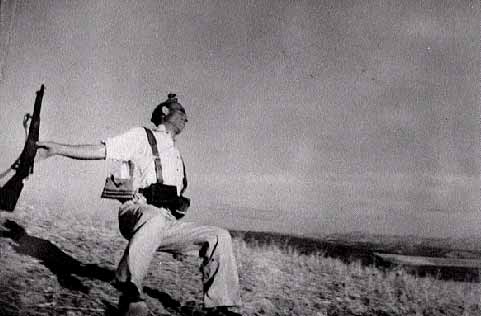 Capa's ability to be at the right place at the right time, i guess is just luck but somehow in all his photographs something amazing is always happening. for example, the photo on the left the man has just been shot.
Capa's ability to be at the right place at the right time, i guess is just luck but somehow in all his photographs something amazing is always happening. for example, the photo on the left the man has just been shot.Tonight I Can Write... By Pablo Neruda
Tonight I can write the saddest lines.
Write, for example, 'The night is shattered
and the blue stars shiver in the distance.'
The night wind revolves in the sky and sings.
Tonight I can write the saddest lines.
I love her, and sometimes she loved me too.
Through nights like this one I held her in my arms.
I kissed her again and again under the endless sky.
She loved me, sometimes I loved her too.
How could one not have loved her great still eyes.
Tonight I can write the saddest lines.
To think that i do not have her. To feel that I have lost her.
To hear the immense night, still more immense without her.
And the verse falls to the soul like dew to the pasture.
What does it matter that my love could not keep her.
The night is shattered and she is not with me.
This is all. In the distance someone is singing. In the distance.
My soul is not satisfied that it has lost her.
My sight searches for her as though to go to her.
My heart looks for her, and she is not with me.
The same night whitening the same trees.
We, of that time, are no longer the same.
I no longer love her, that's certain. but how I loved her.
My voice tried to find the wind to touch her hearing.
Another's. She will be another's. Like my kisses before.
Her voice. Her bright body. Her infinite eyes.
I no longer love her, that's certain, but maybe I love her.
Love is so short, forgetting is so long.
Because through nights like this one I held her in my arms
my soul is not satisfied that it has lost her.
Though this be the last pain that she makes me suffer
and these the last verses that I write for her.
(taken from Love Ten poems By Pablo Neruda)
Pablo Neruda is my favorite poet, his magical ability to turn ordinary words into strings of verbal pearls astounds me. This poem in particular evokes a sense of true love. I automatically look at The Kiss and this poem runs in my head as the inner monologue.
Subscribe to:
Comments (Atom)