Saturday, September 27, 2008
Fauvism & Proto-Cubism
"The Old Guitarist" by Pablo Picasso was created during his blue period, in which he used mostly blue as his color and mood for the pieces. The people of today, when they think of Picasso think of abstract women or very sharp, angular lines with wild colors. While this piece is very clear and smooth with a lot of direct emotion. Let me explain, This work we understand and can associate with directly (he is human, struggling, alone, all things we can associate with as human beings), while in his later work we get emotions from his canvases through the shapes, brush strokes and color. Which is more indirect, it plays off the same emotions, but through the abstract art it plays on the emotions of the subconscious, and not so much the couscous thoughts of struggle or poverty, etc. The contrast from his early work to the work that he is widely known for now is very dramatic

Romantic & Neoclassical
"The Third of May" by Francisco Goya is an artistic account of a bloody massacre of the Spanish by the French. Goya gives the viewer (through his romantic style) a sense of the pain and agony felt by the Spanish being executed. In the 21st century any image of this sort would never or rarely be seen by the public. Now a days, we don't want to see these images. We know in the back of our minds that it is happening all around the world, but to see an actual account in a photograph would be to unpleasant and would ruin our whole day. Also any photograph or painting of this subject matter sparks conversation, if this was a image of our country men being slaughtered by a foreign countries military it would be a wonderful way to unite us to rebel against the foreign invader. But on the other ,if this was an image of us massacring innocent people in another country or for that matter in our own country it would not reflect well on our current administration or political goals. Hence now in the 21st century many photographers are censored and manipulated in the media.
Saturday, September 20, 2008
Expressionist & Symbolism
At one point or another every one has seen a picture, a reference, or even the real thing. "The Scream" by Edvard Munch, is one of the most recognisable works of art in the world. Everyone seems to look at it and with out thought (this can be debatable) automatically relate to it. As should everyone in this day and age. Everyone has at one point or another felt like this. The feeling that the world is melting around you, the anxiety has overtaken you, and all you can do is stop and scream. I admit it, I have done just this more than once. It saddens me to say, most of our days have become this way, but without the relief of a scream. We in he twenty-first century hold it all in till we explode or deflate. Also in the work there is a strong sense of loneliness (signified by the people in the the background walking away and are unaffected by their surroundings) which is another part of our modern day society, politically, as Americans are isolationists by nature, but it also reflects in our culture. Most people are now always on their cellphones, isolated in their big cars trying to get from point A to B quickly and without looking at the scenery or the world they live in. "The Scream" is a reflection of the struggle to cope with the inner pain, but also now in the 21st century it has become a symbol of our isolation from each other.
Neoclassicism
The painting of "Napoleon Crossing The Saint-Bernard" is a majestic picture of Napoleon on his magnificent steed. It instills confidence in the viewer, I couldn't imagine the amount of patriotism and trust felt by the French of this time. Or maybe I could, I myself am not a very patriotic person, but in this day in age and political climate being what it is, most likely many Americans look at the American flag and feel the same as the French and most of France did at that time. In both cases the painting or flag is there to symbolise unity of a nation, but also to give the viewer a sense of confidence and trust in the government, which is dictating his or hers existence each and everyday. In essence it becomes a daily form of propaganda, and possibly that my be it's use.
Friday, September 12, 2008
Impressionist and Post-Impressionist
In the painting "Moulin de la Galette" by Pierre-Auguste Renoir, we see the joy and carefree environment of a party in Paris. Everyone is enjoying themselves and other peoples company, they talk, laugh and dance, they are free to enjoy themselves in anyway they want. Now this painting was painted in 1876, if you change their clothes and possibly their location to modern day dress and place them anywhere in the world it becomes the same parties of today in 2008. We still dance, laugh and enjoy other peoples company. But then why do we seem so detached from the people in the painting. I can't speak for you all but for myself I see no common ground between the people on the canvas and me, but they do represent me. They're young and artsy, but I think the significant difference between me and them is they have no problems. Renoir painted them in a world with no problems, that was his purpose and goal for this painting and he conveys it so well (to me) that the characters in the painting lack one element of humanity...pain... they lack any sense of anguish or regret, they are not worn down by the world, they just party and are having a great time. I envy them.
Rococo & Baroque
The Palace of Versailles is one of the most elaborate chateaus in its time and also in ours. The lavished Baroque style that is present in every crevasse of the compound makes the beholder feel very small and unimportant. I was there many years ago as a child, and it was a remarkable experience, the grand, long hallways of gold and interact paintings surrounding me was overwhelming. I remember thinking how excessive it was. I would catch myself looking at small parts of the massive paintings. The figures of gods and angels paint with such care and detail that i believed if i stared hard enough i could see the flaws in their complexions. My fondest memory though was strolling through the gardens and seeing the fountains, they were my favorite because they were statues with parts that moved, even if it was just water pouring or being spit out by some Greek god, it still had a part that interacted with you. Not directly mind you but indirectly, i realised that this fountain has been doing this for hundreds of years, it fascinated me.
Saturday, September 6, 2008
5 works that explain me

There is no direct explanation of myself through this first piece, but more of a feeling this artist conveys to me. Alberto Giacometti's sculptures give me a sense of sadness and the grinding of time on the body. I can stare at his work for hours, every bump, curve of the this long, stretched figure, i find to be fascinating. Giacometti's ability to convey time and strain of life on an individual is comforting, i look at his work and find myself giving my stress and anxieties to the piece, alleviating some of the burden.

Rodin is one of my favorite artists, of all his works "The
Kiss" (shown here) is my favorite. I think of myself as a romantic, i find this work to be the closest to real genuine love, true romance soft and caring, untainted by greed or jealousy. As silly as it sounds, i strive for what those figures have in my own relationships.

I have been a photographer since the age of seven. All my life I have been inspired by two photographers, Sebastian Salgado (shown above) and Robert Capa (shown below). Salgado one, if not the best portrait photographer, has gone around the world taking photos of starving people in Africa and Asia, and Capa, the best war photographer. Both of these photographers have taught me a lot, though looking at their pictures I have trained my eye to what is a good shot and what's not. Salgado's use of light on his subjects still amazes me.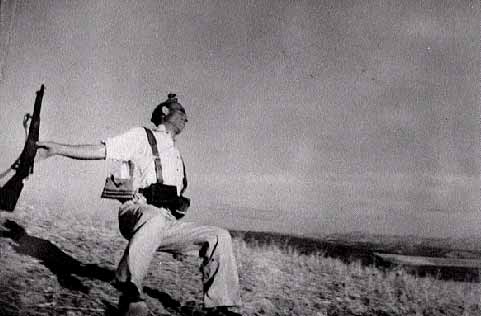 Capa's ability to be at the right place at the right time, i guess is just luck but somehow in all his photographs something amazing is always happening. for example, the photo on the left the man has just been shot.
Capa's ability to be at the right place at the right time, i guess is just luck but somehow in all his photographs something amazing is always happening. for example, the photo on the left the man has just been shot.Tonight I Can Write... By Pablo Neruda
Tonight I can write the saddest lines.
Write, for example, 'The night is shattered
and the blue stars shiver in the distance.'
The night wind revolves in the sky and sings.
Tonight I can write the saddest lines.
I love her, and sometimes she loved me too.
Through nights like this one I held her in my arms.
I kissed her again and again under the endless sky.
She loved me, sometimes I loved her too.
How could one not have loved her great still eyes.
Tonight I can write the saddest lines.
To think that i do not have her. To feel that I have lost her.
To hear the immense night, still more immense without her.
And the verse falls to the soul like dew to the pasture.
What does it matter that my love could not keep her.
The night is shattered and she is not with me.
This is all. In the distance someone is singing. In the distance.
My soul is not satisfied that it has lost her.
My sight searches for her as though to go to her.
My heart looks for her, and she is not with me.
The same night whitening the same trees.
We, of that time, are no longer the same.
I no longer love her, that's certain. but how I loved her.
My voice tried to find the wind to touch her hearing.
Another's. She will be another's. Like my kisses before.
Her voice. Her bright body. Her infinite eyes.
I no longer love her, that's certain, but maybe I love her.
Love is so short, forgetting is so long.
Because through nights like this one I held her in my arms
my soul is not satisfied that it has lost her.
Though this be the last pain that she makes me suffer
and these the last verses that I write for her.
(taken from Love Ten poems By Pablo Neruda)
Pablo Neruda is my favorite poet, his magical ability to turn ordinary words into strings of verbal pearls astounds me. This poem in particular evokes a sense of true love. I automatically look at The Kiss and this poem runs in my head as the inner monologue.
Subscribe to:
Comments (Atom)